Top 5 Best CRM Software for Healthcare Industry [2026 Updated List
Jun 18, 2026 Aiswarya Madhu
You might be here after reading atleast five different definitions of “what is a healthcare CRM.” And yes, I could repeat the same explanation again.
But that is not the part that actually helps you choose the right CRM for your healthcare business.
So instead of starting with what a healthcare CRM is, let’s start with what you are probably missing today and what you should prioritize before you pick one.
Most healthcare teams do not struggle because they lack a CRM. They struggle because patient relationships are being managed across too many disconnected places. Front desk notes in one system. Follow ups in someone’s inbox. Outreach sitting in spreadsheets. Referral status living in phone calls. And when leadership asks, “Where are we losing patients or slowing down care,” nobody has a clean answer.
If that sounds familiar, here is what you should be prioritizing.
- First, you need a system that can give you a single operational view of the patient journey. Not just contact details, but every interaction that affects experience and outcomes. Appointment requests, missed visits, follow ups, referrals, reminders, education, complaints, and service recovery. If your CRM cannot map that journey clearly, you are still running on fragments.
- Second, prioritize workflow over features. Most CRMs look impressive in a demo, but the real question is whether it can automate the repetitive work that is currently draining your team. Appointment confirmations, referral follow ups, care plan nudges, intake reminders, post visit check ins. If those tasks still rely on manual tracking, you are buying software, not solving a problem.
- Third, make communication and coordination a core requirement, not an add on. The right healthcare CRM should reduce the number of places your team needs to check to respond to a patient. It should support secure messaging and structured follow ups. It should also make handoffs between teams smoother, because patient experience breaks down at the handoff, not at the point of care.
- Fourth, treat reporting as a decision tool, not a dashboard. You do not need more charts. You need clear visibility into what is slipping. No show patterns. Referral bottlenecks. Delayed follow ups. Service response times. Patient engagement by program. If your CRM cannot surface these operational signals, you will always be reacting late.
- Finally, none of this matters if data security and compliance are weak. In healthcare, trust is the product. Your CRM must support secure access controls, auditability, and compliant handling of sensitive data. Otherwise adoption will stall and risk will climb.
Once you define these priorities, choosing a CRM becomes much simpler. You stop asking “which one has the most features” and start asking “which one fixes the operational gaps we are living with every day.”
CRM vs EHR in Healthcare: Understanding the Difference Matters
Before comparing healthcare CRM platforms, it is worth stepping back and clarifying a common point of confusion. CRM and EHR systems are often discussed together, yet many healthcare organizations expect one to cover gaps it was never built to address. While both handle patient data, they exist for very different operational reasons. Understanding this difference upfront makes it much easier to evaluate technology choices and avoid misaligned expectations.
| EHR (Electronic Health Records) | CRM (Healthcare CRM) | |
|---|---|---|
| Primary purpose | Supports clinical care delivery and medical decision making | Supports patient relationships, engagement, and operational workflows |
| Core focus | Clinical documentation and treatment | Communication, coordination, growth, and service |
| Type of data managed | Diagnoses, medications, lab results, vitals, imaging, clinical notes | Contact details, preferences, interactions, appointment history, outreach activity |
| Who primarily uses it | Physicians, nurses, clinicians, clinical staff | Front desk teams, patient coordinators, marketing, call centers, care navigation teams |
| Key workflows | Clinical orders, e-prescribing, treatment plans, regulatory reporting | Appointment reminders, referrals, follow-ups, surveys, campaigns, service requests |
| Compliance scope | Clinical compliance standards including HL7 and FHIR | HIPAA compliant handling of engagement and communication data, consent management |
| Analytics focus | Clinical outcomes, quality measures, population health indicators | Engagement performance, retention, acquisition cost, outreach ROI |
| Strength | Acts as the single source of clinical truth | Acts as the system of action for patient engagement and operations |
| Limitation | Poor fit for marketing, outreach, and non-clinical workflows | Not designed to store diagnoses, orders, or clinical records |
| Best role in the stack | Clinical backbone | Engagement and operations engine |
Integration Matters More Than Choosing One
The real value does not come from choosing CRM or EHR. It comes from connecting them correctly.
When integrated using standards like FHIR:
- The EHR supplies clinical context that informs compliant outreach and follow-ups in the CRM
- The CRM feeds engagement history back into care coordination and planning
- Clinical teams stay focused on care, while operational teams manage communication and continuity
This is why mature healthcare organizations treat EHR and CRM as complementary systems, not competing ones. The EHR ensures clinical excellence. The CRM ensures patients do not fall through operational gaps.
Now Let’s see the top five best CRM software for healthcare leaders that’s sure to help you
An Overview of the Leading CRM Platforms in Healthcare
Rather than ranking platforms, this section looks at the top five CRM Software for Healthcare Industry and the specific contexts in which each one delivers the most value.
Salesforce Health Cloud
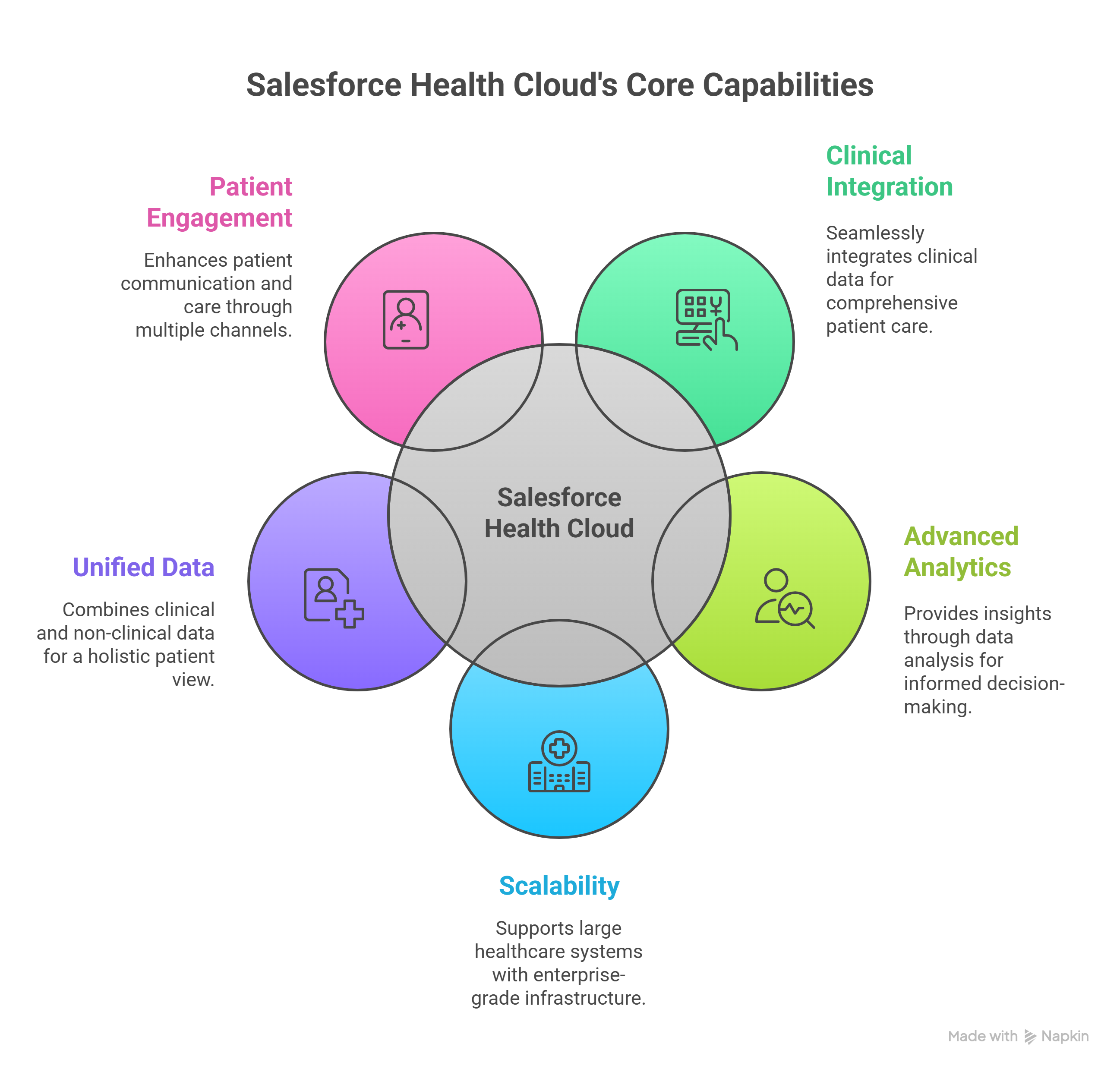
Salesforce Health Cloud is best for Large healthcare systems, payers, life sciences companies, and patient-centric care models that require deep clinical integration, advanced analytics, and enterprise-grade scalability.
Salesforce Health Cloud has earned its reputation as the leading CRM for healthcare because it was built specifically for complex healthcare environments, not adapted from a generic CRM. With adoption across more than 630 healthcare organizations and steady growth over the past several years, it has become the platform of choice for providers and insurers that need to manage care at scale without losing patient context.
What truly differentiates Health Cloud is its ability to unify clinical and non-clinical data in a single operational layer. Instead of treating patients as contacts, it creates a complete, longitudinal view of the patient journey that supports real clinical and operational decision-making.
Healthcare Use Cases
Health Cloud enables healthcare organizations to move from fragmented systems to coordinated care models:
- 360-degree patient profiles that bring together EHR and EMR data, demographics, care plans, engagement history, wearable data, and social determinants of health. This allows teams to personalize care and intervene proactively rather than reactively.
- Longitudinal patient timelines that track interactions across providers, admissions, referrals, and telehealth visits, giving care teams full visibility into the patient journey instead of isolated snapshots.
- Care team collaboration through shared care plans, real-time task assignment, and structured handoffs, reducing administrative burden and improving coordination across departments.
- Multi-channel patient engagement using automated journeys across email, SMS, portals, and contact centers, ensuring patients receive timely, relevant communication at every stage of care.
- Population health and public health programs powered by analytics, risk stratification, and compliance reporting, supporting payers, life sciences organizations, and government initiatives.
Why Salesforce Health Cloud Stands Out?
Salesforce Health Cloud succeeds where traditional CRMs fall short. It combines native healthcare data models, HIPAA-compliant architecture, and built-in analytics with the scalability of a cloud-native platform. Unlike general CRMs that require heavy customization just to handle healthcare data, Health Cloud is designed to support millions of patient records, real-time integrations with leading EHR systems, and continuous innovation through automatic upgrades.
Microsoft Dynamics 365
If you are looking for an ecosystem powerhouse rather than a standalone healthcare CRM, Microsoft Dynamics 365 is designed exactly for that scenario. It does not try to replace how your teams already work. Instead, it extends the Microsoft tools your clinicians, care coordinators, and operations teams already rely on and turns them into a connected healthcare engagement and operations platform.
Dynamics 365 for Healthcare fits naturally into Microsoft-first environments, where email, collaboration, analytics, and identity are already standardized. With the Healthcare Accelerator, organizations can deploy a HIPAA-compliant CRM foundation quickly, using healthcare-ready data models and workflows rather than starting from scratch.
Healthcare Use Cases
Dynamics 365 focuses on embedding patient engagement and operational intelligence directly into everyday Microsoft workflows.
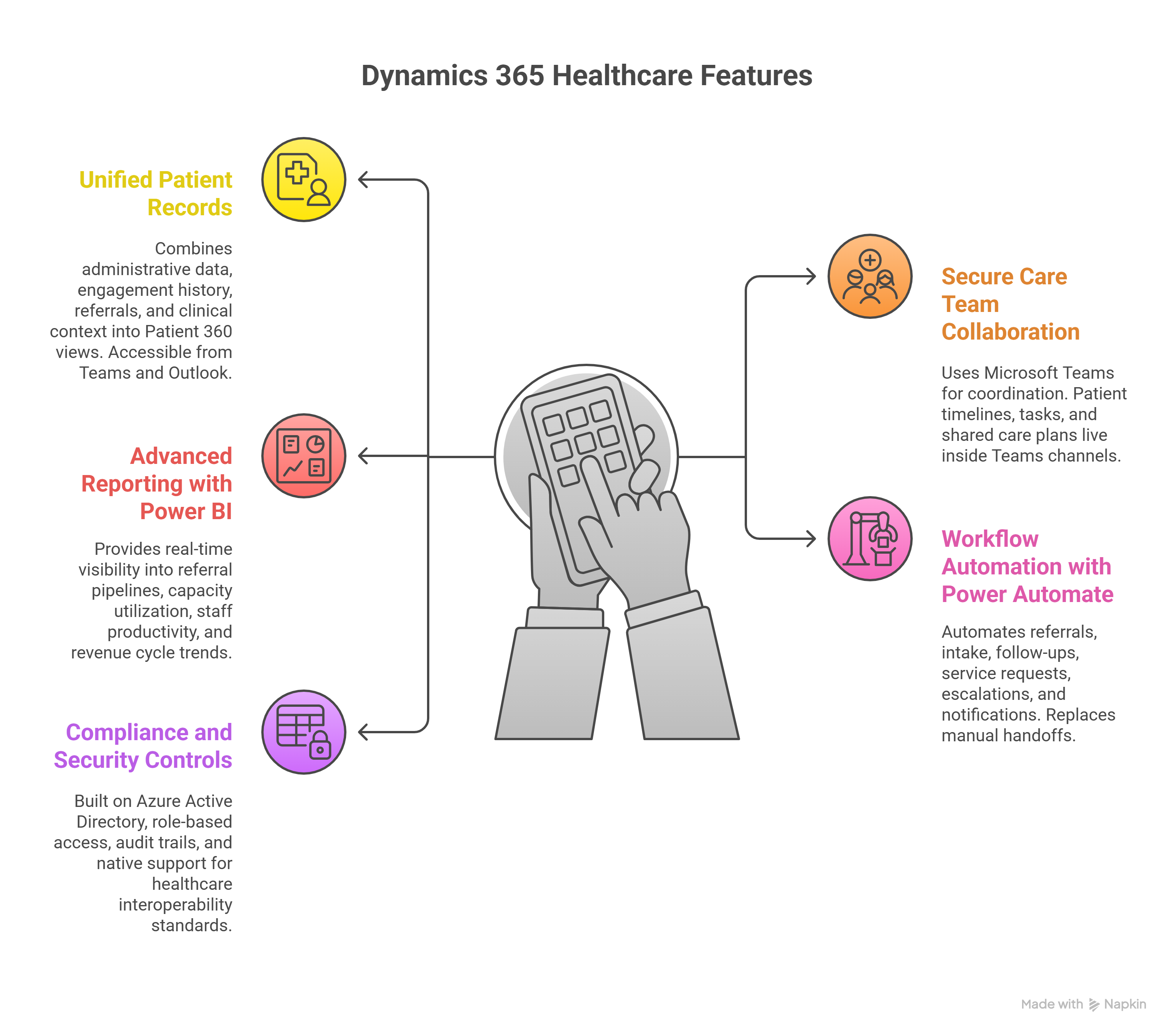
- Unified patient records across the Microsoft stack that combine administrative data, engagement history, referrals, and selected clinical context into Patient 360 views. These records are accessible from Teams and Outlook, reducing context switching and speeding up decision-making.
- Secure, real-time care team collaboration using Microsoft Teams as the coordination layer. Patient timelines, tasks, and shared care plans live inside Teams channels, while Outlook-integrated scheduling and reminders help reduce missed appointments and delayed follow-ups.
- Advanced operational and performance reporting with Power BI, providing leadership with real-time visibility into referral pipelines, capacity utilization, staff productivity, and revenue cycle trends instead of static monthly reports.
- End-to-end workflow automation using Power Automate, covering referrals, intake, follow-ups, service requests, escalations, and notifications. Manual handoffs are replaced with event-driven processes that keep care moving.
- Enterprise-grade compliance and security controls built on Azure Active Directory, role-based access, audit trails, and native support for healthcare interoperability standards such as FHIR and HL7, enabling HIPAA and GDPR compliance without additional tooling.
Why Microsoft Dynamics 365 Stands Out?
Microsoft Dynamics 365 stands out because it minimizes fragmentation. Rather than introducing another disconnected system, it brings CRM capabilities into a single Microsoft-governed ecosystem. Collaboration stays in Teams. Analytics stay in Power BI. Automation runs through Power Platform. Identity and security remain centrally managed through Azure.
Zoho CRM
Zoho CRM consistently earns its place in healthcare not because it tries to compete head-to-head with enterprise platforms, but because it focuses on practical value where smaller and mid-sized healthcare organizations actually feel the pain. Clinics, specialty practices, and healthcare startups choose Zoho when budget discipline, speed, and customization matter more than heavyweight enterprise complexity.
Across 500+ healthcare organizations globally, Zoho CRM users highlight one clear advantage: it delivers most of what enterprise healthcare CRMs offer without the cost, implementation drag, or vendor lock-in. With strong ratings from real users and rapid ROI timelines, Zoho has become a go-to CRM for healthcare teams that need results quickly.
Healthcare Use Cases
Zoho CRM shines in environments where teams are lean, operations are hands-on, and systems must adapt to how the clinic works rather than the other way around.
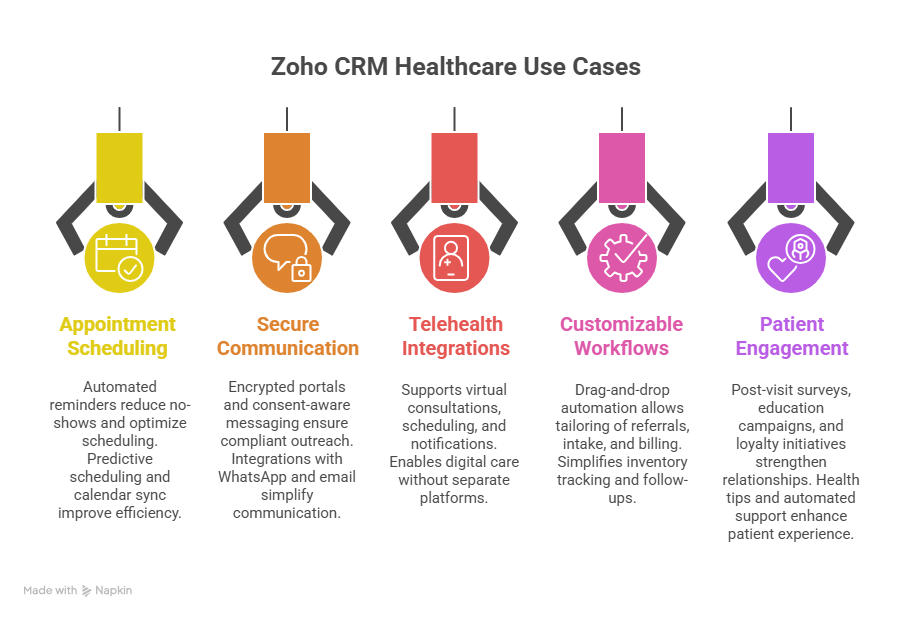
- Appointment scheduling and no-show reduction powered by automated SMS, email, and messaging app reminders. Predictive scheduling and calendar sync help practices proactively reduce missed visits and optimize utilization.
- Secure, multi-channel patient communication through encrypted portals and consent-aware messaging, including integrations with WhatsApp and email, enabling compliant outreach without complicated setups.
- Telehealth-ready integrations that support virtual consultations, scheduling, and patient notifications, allowing smaller practices to offer digital care without investing in separate platforms.
- Highly customizable clinic workflows built using drag-and-drop automation and Zoho Creator. Practices can tailor referrals, intake, billing coordination, inventory tracking, and follow-ups without relying on development teams.
- Patient engagement automation that supports post-visit surveys, education campaigns, health tips, and loyalty initiatives, helping practices strengthen long-term patient relationships.
Why Zoho CRM Stands Out
Zoho CRM stands out because it is built for control and adaptability. Instead of forcing clinics into rigid enterprise processes, it allows healthcare teams to shape the system around their workflows. Deployment is fast, customization is deep, and scalability is incremental rather than overwhelming.
For healthcare organizations that want affordable CRM software for healthcare, rapid time to value, and the freedom to evolve their processes as they grow, Zoho CRM offers a rare balance of flexibility, functionality, and cost efficiency without sacrificing patient engagement or operational discipline.
HubSpot for Healthcare
HubSpot has carved out a strong position in healthcare by focusing on how patients are acquired, engaged, and retained, not just how they are stored in a database. HubSpot serves over 3,000 hospitals and healthcare companies overall, powering marketing and engagement tools tailored for patient acquisition and retention.
Its overall CRM market share stands at about 2.7%, with strong SMB focus and reported growth in healthcare adoption through inbound marketing and automation. Moreover, HubSpot offers a free core CRM that scales, combined with a mature inbound marketing and automation engine.
For healthcare organizations where growth depends on visibility, trust, education, and consistent follow-up, HubSpot turns marketing activity into measurable patient pipelines, with users seeing inbound leads up 310%, deals closed up 73%, and website traffic up 215% after 12 months.
Healthcare Use Cases
HubSpot performs best in healthcare environments where patient journeys start long before the first appointment and continue well after the visit.
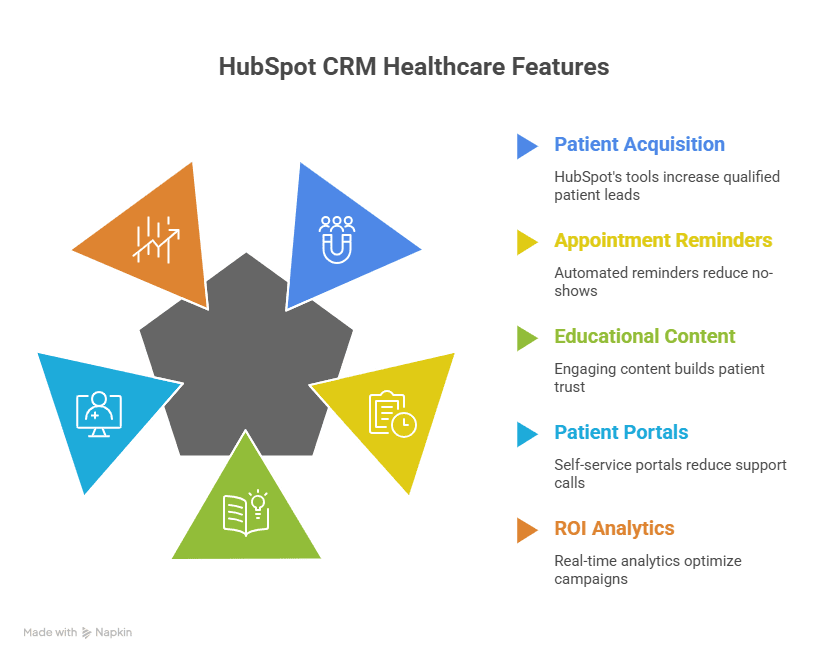
- Patient acquisition and referral tracking through landing pages, forms, lead scoring, and automated nurture programs. Healthcare organizations using HubSpot report up to a 40 percent increase in qualified patient leads by consistently following up on inquiries instead of losing them to manual processes.
- Automated appointment reminders and follow ups using personalized email and SMS sequences with scheduling links. These workflows routinely deliver 25 to 30 percent reductions in no shows, especially for specialty care and behavioral health practices.
- Educational content delivery at scale, including blogs, webinars, guides, and health campaigns triggered by patient behavior. Segmented outreach has shown 32 percent higher engagement rates, helping providers build trust before and after care.
- Patient portals and self service experiences that support appointment booking, bill payment, intake forms, and access to information. Practices report up to a 50 percent reduction in inbound support calls by giving patients simple ways to help themselves.
- Engagement and ROI analytics that connect campaigns directly to outcomes. Teams can track patient acquisition cost, lifetime value, conversion rates, and retention in real time, enabling continuous optimization rather than guesswork.
Why HubSpot Stands Out
HubSpot stands out because it treats healthcare CRM as a growth engine rather than a record system. Native marketing automation, strong analytics, and a generous free tier lower the barrier to entry, while the platform can scale to enterprise use cases without forcing a system migration later.
For healthcare organizations that rely on patient outreach, education, acquisition, and retention, HubSpot offers a CRM that connects marketing performance directly to patient relationships. It is especially well suited for practices and healthcare brands that see engagement as a strategic advantage and want measurable returns from every campaign while maintaining secure data handling.
Pegasystems
Pega Healthcare CRM is designed for healthcare organizations where complexity is the norm, not the exception. It is not a lightweight engagement tool or a marketing-led CRM. Pega is built for environments where care journeys involve multiple stakeholders, dynamic rules, regulatory constraints, and constant decision-making across clinical, administrative, and payer workflows.
Large health systems, payers, and life sciences organizations adopt Pega when manual processes and static workflows become a bottleneck. Recognized by Gartner in 2025 for its strengths in automation and decisioning, customers using Pega Infinity report 50% faster case resolution and 40% productivity gains through AI orchestration and low-code development.
At its core, Pega combines low-code BPM, real-time AI decisioning, and deep system integrations to manage care as an end-to-end, continuously adapting process.
Healthcare Use Cases
Pega is purpose-built for scenarios where care and operations must adapt in real time rather than follow fixed paths.
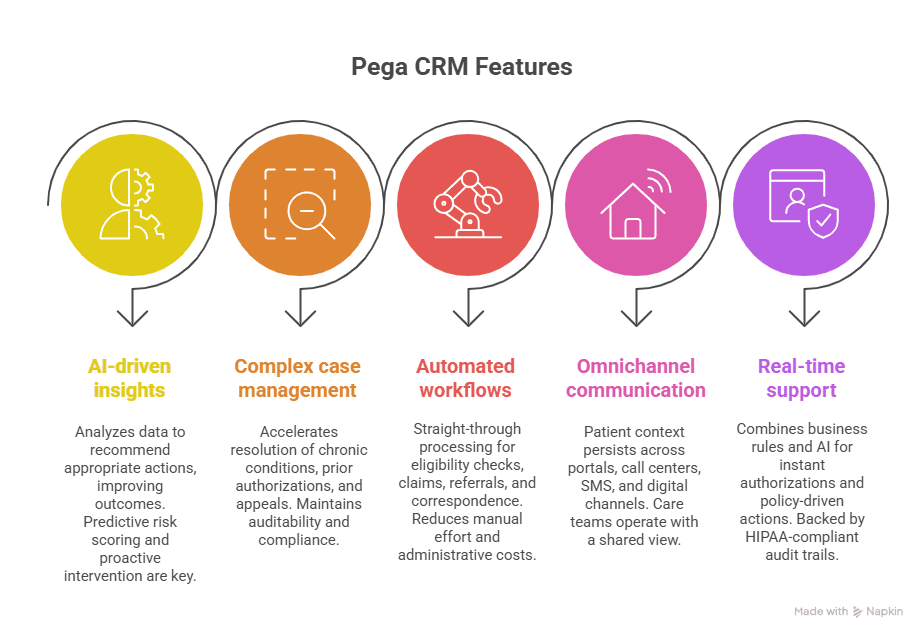
- AI-driven patient and member insights using Pega’s Next-Best-Action engine, which analyzes clinical signals, behavioral data, and social determinants to recommend the most appropriate actions. Organizations report measurable improvements in outcomes through predictive risk scoring and proactive intervention.
- Complex case management for high-touch care such as chronic condition management, prior authorizations, appeals, and utilization review. Visual BPM and dynamic routing accelerate resolution while maintaining full auditability and compliance.
- Automated administrative workflows with straight-through processing for eligibility checks, claims handling, referrals, and correspondence. These automations significantly reduce manual effort and administrative costs at scale.
- True omnichannel communication orchestration, where patient or member context persists across portals, call centers, SMS, and digital channels. Care teams and service agents operate with a single, shared view instead of fragmented interactions.
- Real-time decision support and compliance enforcement, combining embedded business rules and AI to support instant authorizations, care gap closure, and policy-driven actions, all backed by HIPAA-compliant audit trails.
Why Pega Healthcare CRM Stands Out?
Pega stands out because it treats healthcare CRM as a decision and process orchestration layer, not just a relationship database. Where traditional CRMs struggle with dynamic, high-volume, and regulated workflows, Pega thrives by combining AI-driven decisioning with visual, low-code process automation.
Conclusion
If you are expecting a definitive answer to which healthcare CRM you should choose, the reality is this: there isn’t one. Every healthcare organization operates with different constraints, priorities, and maturity levels. What works perfectly for a large integrated delivery network may be excessive for a growing specialty clinic. What fits a marketing-led healthcare brand may fall short in a high-complexity care environment.
This is why selecting a healthcare CRM is rarely just a software decision. It is an operational and architectural decision.
It often helps to work with a CRM service provider who understands healthcare workflows, not just CRM platforms. The right partner will step back and assess how patient journeys flow today, where handoffs break, how your EHR is being used, and which teams are carrying the most operational load. From there, they can recommend a CRM platform that aligns with your goals, design the right integration approach, and configure workflows that actually get adopted.
A good CRM implementation does not start with features or demos. It starts with clarity, prioritization, and guidance. With the right consulting support, you move away from trial-and-error selection and toward a CRM strategy that fits your healthcare business today and scales with you tomorrow.
Recent Posts

Dynamics 365 Activate: Do You Still Need a Migration Partner?
Oct 05, 2026

Tableau to Power BI Migration: A Practical Guide
Sep 09, 2026
SAP ECC to Dynamics 365 Finance & SCM Migration Guide
Sep 09, 2026
Category
Our Expertise



About Author

Aiswarya Madhu
Aiswarya Madhu is an experienced content writer with extensive expertise in Microsoft Dynamics 365 and related Microsoft technologies. With over four years of experience in the technology domain, she has developed a deep understanding of Dynamics 365 applications, licensing, integrations, and their role in driving digital transformation for organizations across industries.
Never Miss News
Want to implement Dynamics 365?
We have plans which will meet your needs, and if not we can tweak them around a bit too!